Join Mary Jo Leddy to explore the issues shaping Canada’s future
- Delivery: In-person on campus at the University of St. Michael’s College in the University of Toronto
- Duration: 4 weeks
- Day of the week: Thursdays
- Dates: Thursday April 16 – Thursday May 7, 2026
- Time: 4:00 pm to 6:00 pm
- Location: Mary Ward Centre, Loretto College Residence, 70 St. Mary St
- Cost: $225 (includes HST) **15% discount available to alumni of the University of St. Michael’s College and seniors 65+
Course Overview
Join acclaimed author and human rights advocate Mary Jo Leddy in an exploration of Canada’s pressing moral challenges. Through discussions on our relationships with Indigenous peoples, immigration, and environmental stewardship, Leddy will invite participants to critically examine the question, “Why are we here?” Drawing from her Catholic worldview yet addressing all Canadians, she challenges us to reframe our attitudes towards our shared land, fostering a collective sense of gratitude and responsibility. Reflecting on belonging, hope, and civic purpose, Leddy invites us to imagine Canada as a sanctuary for the human spirit.
Method of Teaching
This course will rely on both lecture and seminar mode of instruction, with a strong emphasis on discussion and critical analysis of course concepts, using Leddy’s 2019 book Why Are We Here? A Meditation on Canada as a source text (you may bring your own copy, or purchase a copy for $17).
Learning Outcomes
In this course, learners will:
- Identify and discuss Canada’s social and environmental challenges through a moral lens.
- Reflect on Canada’s national identity in relation to Indigenous, immigrant, and environmental perspectives.
- Explore themes of gratitude and responsibility in fostering a sustainable and inclusive future.
About the Instructor

Mary Jo Leddy founded and works at the Romero House Community in Toronto, a unique organization which provides housing and supports to refugees, many of whom live in community with staff. Mary Jo is the author of several books including Why Are We Here?, The Other Face of God and Radical Gratitude. She is the recipient of numerous awards, including the Canadian Council of Christians and Jews Human Relations Award, the Ontario Citizenship Award, and the Order of Canada. She teaches at Regis College.
Questions?
Stay Connected
Register Now
Subscribe to Our Mailing List
Please sign up for the latest news about our courses, programs, workshops, special lectures, and more.

Mappa Mundi: Mapping the Mediaeval World
- Delivery: In-person
- Date: Saturday, April 11th, 2026 – registration deadline Friday March 27
- Time: Registration: 8:30 a.m. | Symposium: 8:45 a.m. – 4:30 p.m.
- Location:
- Symposium: Charbonnel Lounge, Elmsley Hall, 81 St. Mary St
- Lunch: Romero Room, Loretto College, 70 St. Mary St
- Cost:$150 (includes HST, coffee/tea and a Mediaeval lunch)
Explore Mediaeval Mapping
Mappa mundi: Mapping the Mediaeval World will explore that mediaeval Europe from two perspectives: how mediaeval people configured their world and how mediaevalists are employing mapping to better understand that world. In the Middle Ages there were various types of maps intended to illustrate different ideas: the earth’s spherical shape complemented by continents (generally Europe, Asia, Africa, and an unknown continent, referred to as the Antipodes). Maps could depict holy sites and pilgrimage routes or different people, animals and even the unknown creatures that might inhabit space out of sight, just beyond the earth’s margins: “hic sunt dracones” (Here be dragons!). Our exploration of mediaeval mapping will take us across the mediaeval Europe and beyond, demonstrating just how well-travelled mediaeval people were. Some maps could be used in battle, others were for trade, and till mapped the seas. We will also move into micro spaces, mapping cities, and even neighbourhoods, to better understand mediaeval people’s daily lives and the challenges they could face from nature and society.
Hosted by Jacqueline Murray, University Professor Emerita, University of Guelph; Fellow, St. Michael’s College; and Fellow of the Royal Society of Canada
Learning Outcomes
This Mediaeval Saturday Symposium will provide the opportunity for participants to map and re-map our own understanding of the Middle Ages and mediaeval European society
2026 Mediaeval Symposium Presenters
James Ginther
Professor of Mediaeval Theology
Regis St. Michael’s Faculty of Theology
University of St. Michael’s College
Title: Trading with Strangers in a Strange World: An Unnoticed Marine Map of the Mediaeval World.
Abstract: There were different ways to represent the known world during the Middle Ages. One type of map this is often overlooked is the marine or portolan map. This type of map was created to assist sailors and merchants as they travelled to find sources for the many goods in demand in Mediaeval Europe. Scholars have argued that this kind of map originated in the fourteenth century, but we will explore an early map, from the mid-thirteenth century, that has only been recently discovered. While its accuracy does show that it was designed for marine use, the wealth of information it contains helps us understand how mediaeval Europeans saw the world outside of Europe.
Renée R. Trilling
Angus Cameron Professor of Old English
Centre for Mediaeval Studies / Department of English
University of Toronto
Title: A Cure for What Ails You: Traveling the World through Early English Medical Texts
Abstract: Early mediaeval medicine is often dismissed as superstition. While mediaeval people did have some rather fanciful practices, like reciting charms for protection against dwarves and elves, they also made use of many trusted remedies made from herbs and animal ingredients. And some of them actually worked. What’s just as interesting, though, is the way that mediaeval medical texts can help to map the connections between mediaeval England and the wider world. From sourcing ingredients to compiling the latest medical knowledge, the healing arts connected early Insular culture with people and places from Europe and the Mediterranean to North Africa, India, and beyond.
Emily Hutchison
Associate Professor
Department of History
Mount Royal University (Alberta)
Title: Mapping Climate Crises in Late Mediaeval Paris
Abstract: This presentation investigates a series of climate-related crises that afflicted Paris and the Île-de-France during the late Middle Ages, at the onset of the Little Ice Age. It pursues two principal objectives. First, it uses textual evidence to assess the material repercussions of the crises on the city and its people. Second, it uses mapping to analyze these repercussions within in specific neighbourhoods in Paris. Mapping the effects of mediaeval climate change, is indispensable to understanding how it effected Parisians: without attention to the spatial dimensions of environmental disruption, analysis of the impact of the Little Ice Age risks remaining abstract and unmoored from lived reality.
Vanessa McCarthy
Fellow
Centre for Renaissance and Reformation Studies
University of Toronto
Title: Mapping Sex-Workers in Mediaeval Bologna
Abstract: Mapping the residential patterns of working-poor sex workers in mediaeval Bologna reveals that far from being marginalized outcasts, sex-workers chose their neighbourhoods and their neighbours, usually other working-poor men and women, as well as students. Like their friends and family, prostitutes tended to move every two years, but never more than a block or two from their base. Neighbourhood mapping reveals that rather than being shunned because of their sex-work, these women were integrated into their local neighbourhoods and the wider religious, political, and economic life of the city.
Kelly DeVries
Professor Emeritus
Department of History
Loyola University Maryland
Title: The Technology and Portability of Premodern Maps
Abstract: Mediaeval maps are now found in museums, libraries, churches, even palaces and private homes. They are drawn on different media and different technologies were used to construct them. Many depict the world as it was then known and are sometimes populated by mythological people and beasts. Before the fifteenth century, when vivid portolan maps started to appear, the purpose of mediaeval maps is not immediately clear, beyond being artistic or decorative. This paper will discuss the history and technology of mediaeval maps and, more importantly, their portability. Why were premodern mapmakers so eager to portray the “entire world” rather than limited and nearby areas? We will conclude with a brief introduction to portolan maps, so critical for later nautical long-distance navigation and exploration.
Stay Connected
Registration is now closed.
Subscribe to Our Mailing List
Please sign up for the latest news about our courses, programs, workshops, special lectures, and more.

Unlock Your Inner Voice: Join Our Spiritual Writing Workshop!
- Duration: Full-Day Workshop
- Day of the Week: Saturday
- Date: March 28, 2026
- Time: 10:00 am – 3:00 pm
- Location: Mary Ward Centre, Loretto College Residence, 70 St. Mary St
- Cost: $100.00 (includes HST)
Longing to connect on a deeper level? Looking to explore questions that keep arising? Come. Be inspired. Follow your pen into Mystery. Pray on paper. Write towards a deeper understanding of who you were, who you are, and who you are called to be.
No previous writing experience is necessary.
Come to our safe, affirming circle with an open heart, an empty notebook, and leave with a practice that will challenge, console and delight. We follow the Amherst Writers and Artists Method in which you learn to trust your own voice.
**Coffee will be provided, please plan to bring a litterless lunch or purchase lunch from a local café**
Learning Outcomes:
In this workshop, participants will:
Explore a Reflective Writing Practice: Participants will practice a unique method of approaching personal writing practice that encourages introspection, creative exploration, and a deeper sense of self-awareness.
Deepen Spiritual Insight and Connection: Participants will explore their inner experiences and spiritual questions, fostering a deeper connection to self and others within a supportive, reflective community.
About the Instructors
Kate Marshall Flaherty has taught writing as a spiritual practice, meditation, and mindfulness, and now teaches in the social responsibility and sustainability modules at the University of St. Michael’s College in the University of Toronto. Author of seven books of poetry, Kate guides Stillpoint writing workshops in the Amherst Writers and Artists Method. She and Susie have written together for decades.
Susie Whelehan spent 32 years teaching children that God loved them as they were, and recently co-facilitated a course called “Poetry, Prayer and the Political Moment” in Continuing Education at the University of St. Michael’s College in the University of Toronto in the Fall 2024 semester. She writes poetry (and has published one poetry collection, The Sky Laughs at Borders), essays, memoirs, and guides Oasis writing workshops in the AWA method.
Questions?
Stay Connected
Register Now
Subscribe to Our Mailing List
Please sign up for the latest news about our courses, programs, workshops, special lectures, and more.

Create hand-bound works of art
- Duration: 4 Weeks
- Day of the Week: Thursday
- Time: 6:30 p.m. – 9:00 p.m.
- Dates: Thursday January 22, 2026 to Thursday, February 12, 2026
- Delivery: In-person, Kelly Library Print Studio, 113 St. Joseph St., Toronto
- Cost: $290 (includes HST & materials) **15% discount available to alumni of the University of St. Michael’s College and seniors 65+
Course Overview
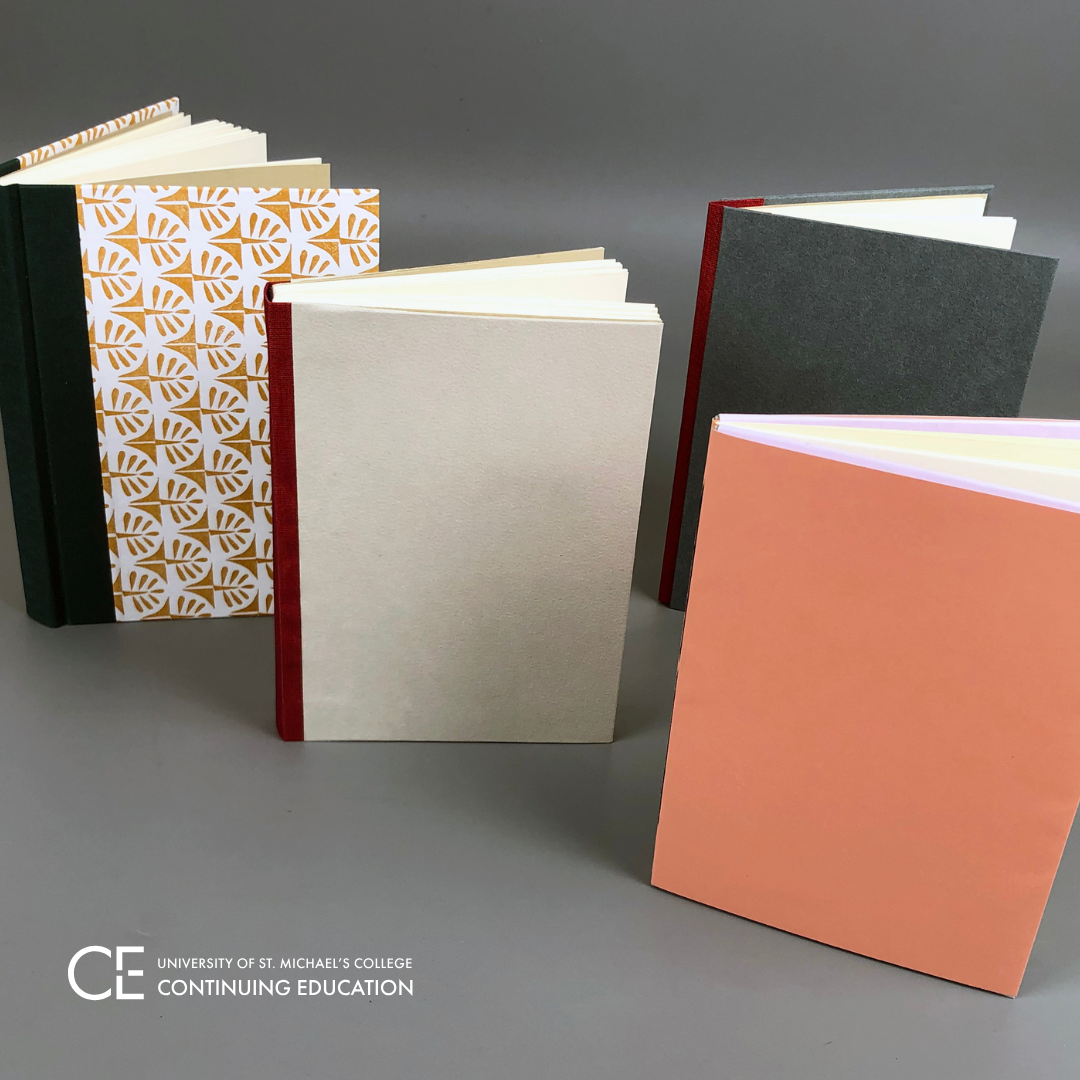
In this course, we will explore two variations of hard-covered books with multiple sections, the Sewn Board Binding and Case Bound styles:
Sewn Board Binding style allows for flat opening of the book and laminated thin boards.
Case Bound books have the traditional look of a shelf-ready hardcover tome. The two structures are sewn and glued, covered in cloth and paper, and can be used as journals, sketchbooks, or artist’s books.
This course is suitable for learners of all levels, no previous bookbinding experience is required.
Method of Instruction
This course combines guided demonstrations with hands-on practice to teach two hardcover book structures. Learners will explore the flat-opening Sewn Board Binding and the traditional Case Bound Book. Each project involves sewing, gluing, and covering with cloth or paper, with step-by-step instruction ensuring mastery of each technique. Small-group guidance and individual feedback will support learners in refining skills and troubleshooting challenges, resulting in three completed books suitable for use as journals, sketchbooks, or artist’s books.
Learning Outcomes
In this course, you will:
- Develop skills in creating book structures.
- Learn techniques of sewing, gluing, and covering books with cloth and paper.
- Explore the practical applications of these book forms for personal projects, such as journals, sketchbooks, or artist books, and their potential for customization.
About the Instructor

Andrew Huot is a book artist and bookbinder in Toronto, ON, Canada, where he operates Big River Bindery. He taught bookbinding, conservation, and preservation at the School of Information Sciences at the University of Illinois for 12 years. In addition to conservation and bookbinding, he teaches bookbinding and book arts in his Scarborough studio, for the Canadian Bookbinders and Book Artists Guild, and at arts centres around Toronto. He holds a Master’s in Book Arts from the University of the Arts in Philadelphia, and his artists’ books use photographs, linoleum cuts, and text to share the humorous side of everyday life. His artists’ books are in collections including the Art Institute of Chicago, Yale University, Emory University, and Ontario College of Art & Design. See more of his work at bigriverbindery.com and andrewhuot.com
Questions?
Please contact ce.stmikes@utoronto.ca
This course is now full.

Please subscribe to our mailing list for the latest news about our courses, programs, workshops, special lectures, and more.
Create beautiful hand-bound books
- Duration: 4 Weeks
Dates: February 26th to March 19th, 2026 - Day of the Week: Thursday
- Time: 6:30 pm – 9:00 pm
- Delivery: In-person
- Location: Kelly Library Print Studio, 113 St. Joseph St., Toronto
- Cost: $290 (includes HST & materials) **15% discount available to alumni of the University of St. Michael’s College and seniors 65+
In this course, learners will be working with more advanced book structures. We will explore two variations of hard-covered books with multiple sections. The first, Sewn Board Binding, is a variation allowing for flat opening of the book and laminated thin boards. The last, Case Bound Book, has the traditional look of a shelf-ready hardcover tome. The two structures are sewn and glued, covered in cloth and paper, and can be used as journals, sketchbooks, or artist’s books.
Method of Instruction
This course combines guided demonstrations with hands-on practice to teach two hardcover book structures. Learners will explore the flat-opening Sewn Board Binding and the traditional Case Bound Book. Each project involves sewing, gluing, and covering with cloth or paper, with step-by-step instruction ensuring mastery of each technique. Small-group guidance and individual feedback will support learners in refining skills and troubleshooting challenges, resulting in three completed books suitable for use as journals, sketchbooks, or artist’s books.
Learning Outcomes
In this workshop, participants will:
- Develop skills in creating advanced book structures
- Learn techniques of sewing, gluing, and covering books with cloth and paper
- Explore the practical applications of these book forms for personal projects, such as journals, sketchbooks, or artist books, and their potential for customization
About the Instructor

Andrew Huot is a book artist and bookbinder in Toronto, ON, Canada, where he operates Big River Bindery. He taught bookbinding, conservation, and preservation at the School of Information Sciences at the University of Illinois for 12 years. In addition to conservation and bookbinding, he teaches bookbinding and book arts in his Scarborough studio, for the Canadian Bookbinders and Book Artists Guild, and at arts centres around Toronto. He holds a Master’s in Book Arts from the University of the Arts in Philadelphia, and his artists’ books use photographs, linoleum cuts, and text to share the humorous side of everyday life. His artists’ books are in collections including the Art Institute of Chicago, Yale University, Emory University, and Ontario College of Art & Design. See more of his work at bigriverbindery.com and andrewhuot.com