



Bold conversations for choosing courage over cynicism

Join Continuing Education for a FREE series of bold conversations for people choosing hope and meeting the world’s challenges with purpose. With so many reasons for despair, where are we finding real cause for hope?
Join Continuing Education at the University of St. Michael’s College for a free speaker series exploring how hope becomes action in sustainability, leadership, social impact, spirituality, education, technology, and the arts.
Hope is not wishful thinking. It is the decision to engage with our world’s most urgent challenges and work toward meaningful change , from climate and culture to how we live our values in our workplaces and communities.
Hope in Action brings together innovators, faculty, alumni, and leaders who are meeting urgent challenges with clarity, courage, and purpose.
Come to be inspired. Leave ready to act.
November 2026
Building Hope: Reimagining Institutions for Human Flourishing

What if hope is not simply a feeling, but an important strategic tool for building infrastructure?
In a time of precarity, fragmentation, burnout, and democratic uncertainty, what would be possible if we stepped outside of the constrictions of scarcity and austerity and oriented toward abundance to reimagine how our public-serving higher education institutions can be places where hope can become a force for collective renewal?
In this webinar, Dr. Jessica Riddell (professor of Early Modern Literature at Bishop’s University and founder of the Hope Circuits Institute) will join Dr. David Sylvester (President and Vice-Chancellor of the University of St. Michael’s College) to discuss the transformative role that hope plays in building vibrant institutions. Drawing on her work with the Hope Circuits Institute and her forthcoming book, Hope Circuits Illuminated: Conversations with Luminaries Amid Collapse, Dr. Riddell will share practical tools, reflections and insights from engaging in thousands of hours of conversations with scholars, students, presidents, staff, artists, and public thinkers to explore how public educational institutions can reclaim their civic purpose and embrace the complexity of our world to imagine new futures.
Featured Speakers

Dr. Jessica Riddell
Dr. Jessica Riddell is a Full Professor of Early Modern Literature at Bishop’s University (Québec, Canada) and the inaugural holder of the Stephen A. Jarislowsky Chair of Undergraduate Teaching Excellence. A nationally recognized educator, public intellectual, and institutional leader, she is widely known for her work on reimagining universities as public institutions oriented toward human and ecological flourishing.
Across her research, teaching, governance, and administrative leadership, Dr. Riddell works at the intersection of the humanities, higher education policy, and systems-level institutional change. She is the founder and director of the Hope Circuits Institute, a national platform for collective sense-making and strategic renewal in higher education. Through this work, she has engaged more than 70 postsecondary institutions and over 40 associations through board retreats, senior leadership engagements, senate dialogues, and campus-wide processes focused on governance renewal, strategic planning, student success, organizational culture, and institutional trust.
Dr. Riddell is an award-winning scholar and best-selling author whose publications span Shakespeare studies, public humanities, pedagogical innovation, and higher education reform. Her book Shakespeare’s Guide to Hope, Life, and Learning (University of Toronto Press, 2023), co-authored with Drs. Lisa Dickson and Shannon Murray, offers an innovative model of humanities scholarship that bridges scholarly rigor and public engagement. Her most recent book, Hope Circuits: Rewiring Universities and Other Systems for Human Flourishing (McGill-Queen’s University Press, 2024), is widely regarded as a landmark contribution to Canadian higher education, articulating a relational framework for institutional renewal grounded in ethical imagination, governance, and critical hope.
A leading public scholar, Dr. Riddell writes regularly for The Globe and Mail, University Affairs, and The Conversation, and is a frequent keynote speaker in Canada and internationally. She has received competitive funding from SSHRC, the Jarislowsky Foundation, the McConnell Foundation, CEWIL Canada, and the Business/Higher Education Roundtable.

Dr. David Sylvester
Dr. David Sylvester is currently in his 27th year as a Canadian university and college president. He was appointed the 8th President and Vice-Chancellor of the University of St. Michael’s College in the University of Toronto in 2018. Previously, David served two terms as Principal of King’s University College at Western, was the founding President of Corpus Christi College of liberal arts established at UBC and the first lay principal of St. Mark’s Theological College, Vancouver. A professor of medieval social and economic history, he holds an M.A. and a Ph.D. from Fordham University, New York City and has taught for three decades in universities in Canada and the United States.
David currently serves on the International Committee and is past chair of the Governance Committee of Universities Canada. He also serves on the boards of the Pontifical Institute of Mediaeval Studies and the Toronto School of Theology at the University of Toronto. Former national chair of the Association of Catholic Colleges and Universities of Canada and co-chair of the Institute for New Presidents for the 225-member Association of Catholic Colleges and Universities’ based in Washington, D.C. he also served for four years on the Board of the Canadian Federation of the Humanities and Social Sciences.
In addition to his interest in university governance development, David is committed to advancing the role of universities as agents of community impact, especially in response to the TRC calls to action and the climate emergency before us.
Details
Wednesday, November 18th, 2026
12:00 to 1:00 p.m.
Online via Zoom
FREE
Previous Talks
September 2026
Hoping in the Face of Crisis: The Role of Hope in Climate Action (IN PERSON)
Featured Speakers

Dr. Hilda P. Koster
Hilda P. Koster is the Sisters of St. Joseph of Toronto Associate Professor of Ecological Theology and the Director of the Elliott Allen Institute for Theology and Ecology at the Regis St. Michael’s Faculty of Theology. A native of the Netherlands, she holds a BA and MDiv from the University of Groningen (The Netherlands), a ThM from Princeton Theological Seminary (NJ/USA) and a PhD from the Divinity School of the University of Chicago. Prior to joining the Regis St Michael’s Faculty of Theology, Dr. Koster served as an Associate Professor in Theology and Environmental Studies at Concordia College (Moorhead, MN).

Sabrina M. Chiefari
Sabrina M. Chiefari is an Environmental Educator whose work centers on community engagement, outdoor education and environmental well-being. She earned her Bachelor’s Degree in Environmental Studies from York University, completed an internship with the Quebec-Labrador Foundation, and spent almost 15 years with the Toronto & Region Conservation Authority delivering diverse formats of educational programming. Sabrina is currently the Integral Ecology Specialist for the Sisters of St. Joseph of Toronto’s Ministry for Social Justice, Peace, and Creation Care.
June 2026
Creating Space for Inclusive Masculinity
Reimagining masculinity through inclusion, authenticity, empathy, growth, and belonging.
Boys and young men today confront a minefield of messages about manhood. Expectations and pressure to perform a certain type of masculinity can cause harm and isolation, and limit the permission boys give themselves to show up in the world as their authentic selves. What would be possible if inclusion, grace, humility, and radical acceptance created explicit foundations for spaces where boys can grow into the fullness and complexity of their identities in ways that honour and respect the unique gifts that manhood brings?
In this webinar, Jesse Brodka and Michael Specht (Director of Mission & Ministry and Campus Minister/Religion teacher at St. Joseph’s Collegiate Institute in Buffalo, NY) will join Jonathon Reed (Director of Programs at Next Gen Men, a Canadian nonprofit dedicated to changing how the world sees, acts and thinks about masculinity ) in conversation to discuss how schools and organizations can design and implement positive, healthy changes to support the spiritual, social, emotional and physical growth of boys and young men.
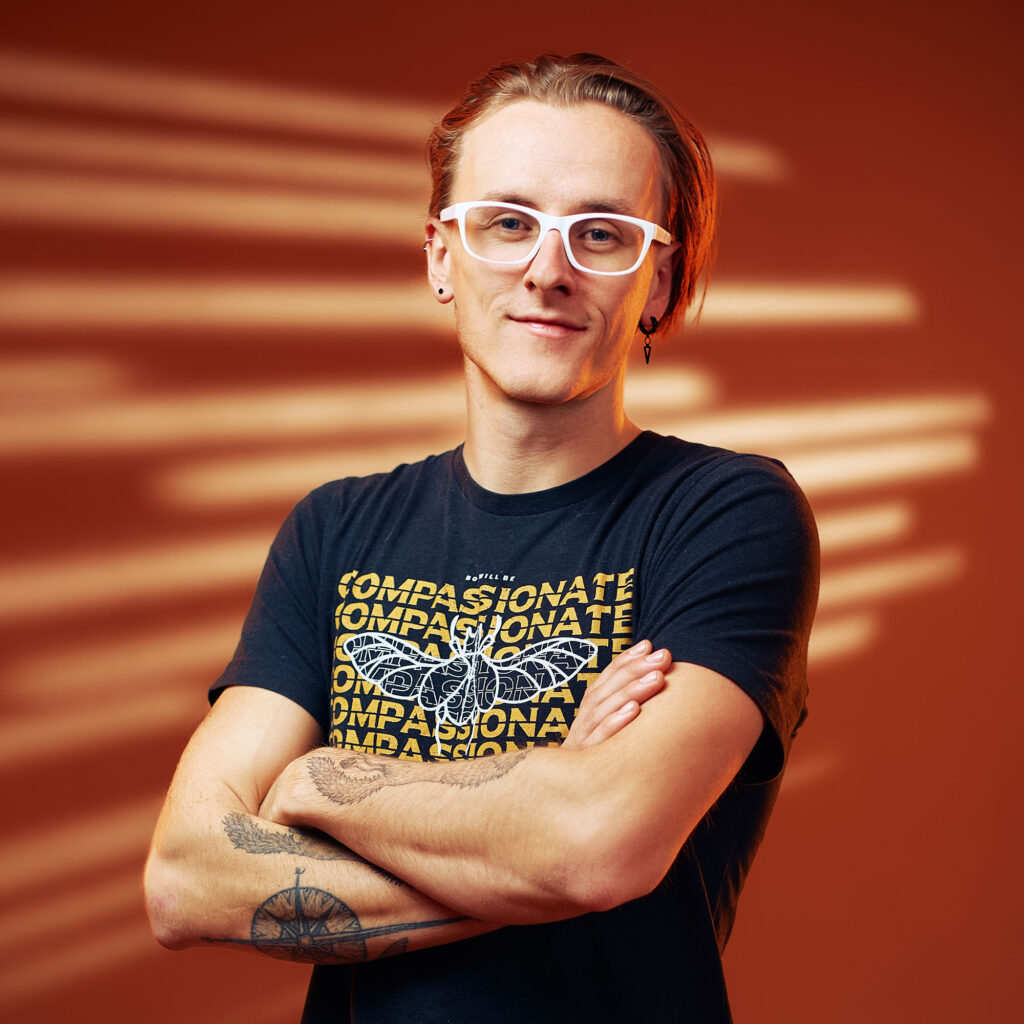
Jonathon Reed
Jonathon Reed is the Director of Programs for Next Gen Men. Jonathon is a leader in supporting boys’ well-being and deepening their capacity for gender-based violence prevention. He started out as a camp counsellor and then teacher before joining Next Gen Men’s school-based programming in order to follow his passion for helping boys become their best selves. He’s probably better at Fortnite than you. He’s definitely worse than your son.
Read his Time Magazine article on healthy online spaces for boys here

Jesse Smokowski Brodka
Jesse Smokowski Brodka is the Director of Mission and Ministry at St. Joseph’s Collegiate Institute, a Catholic High School for young men in Buffalo, NY. Jesse works to bring the Lasallian values of faith, service, and community to the students and staff at St. Joe’s. He is also a graduate student working towards a Doctorate in Education at St. Mary’s University of Minnesota.

Michael Specht
Michael Specht is a Campus Minister & Religion Teacher at St. Joseph’s Collegiate Institute in Buffalo, NY. A proud alumnus of Catholic Theological Union (along with Pope Leo XIV), Mike is passionate about the Second Vatican Council’s call to look into the “Signs of the times and interpret them in the light of the Gospel.” Through his courses and Campus Ministry initiatives, Mike seeks to equip his students with a practical theological worldview that allows them to connect with the Divine, foster community, serve our sisters and brothers in need, and advocate for a more just world
May 2026
Better Conversations to Thrive in Difficult Times
Examining Language and Communication Techniques for a More Hopeful Future
In the middle of an omnicrisis, how does one stay hopeful enough to take effective action? Having any hope can seem naive in times like these, amid wars, worsening climate disaster, populist autocracies on the rise, technology that destabilizes jobs and lives, and on and on.
But hope is always available, if you know how to find it. In conversation with strategist and writer Malcolm Gilderdale, communication scientist, educator, and author Dr. Haesun Moon will explain how better conversations can make us more hopeful and more effective, and practical methods for our own lives. Dr. Moon believes a deeper understanding of language and cognition can help us reshape our understanding of what’s possible in our own lives, in our personal relationships, and in our communities more broadly.
Through pragmatic, practical explanations (and her trademark sense of humour), Dr. Moon will help us shift our orientation toward hopefulness and find a way forward to what she calls “the preferred future.”

Dr. Haesun Moon
Haesun Moon, Ph.D., is a communication scientist, an educator, and author of Coaching A to Z: The Extraordinary Use of Ordinary Words and several collaborative books, including Thriving Women, Thriving World, and Foundations of Brief Coaching, a short handbook for professional coaches.
Haesun received her Ph.D. in Adult Education and Community Development from University of Toronto. She cares about people experiencing better conversations at home and at work – and she does that by training, coaching, and consulting. She believes that conversations can change the world, and she defines this process as hosting dialogic conditions in which people participate to imagineer and perform their preferred change. Her academic and professional research in coaching dialogues and pedagogy from the University of Toronto led to development of a simple coaching model, Dialogic Orientation Quadrant (DOQ).
The DOQ has transformed the way people coach and learn coaching worldwide. Haesun teaches Brief Coaching at the University of Toronto and serves as Executive Director at the Canadian Centre for Brief Coaching, and Principal at The Human Learning Institute. When not writing, Haesun enjoys filmmaking, carpentry, and golf. Haesun is a lover of early mornings, naps, good coffee, and fine pens with fine nibs, currently residing in Toronto with her mother and two exceptionally affectionate and independent dogs. You can visit her online at www.briefcoaching.ca and www.coachingatoz.com

Malcolm Gilderdale
Malcolm Gilderdale is a marketing strategist, writer, and thinker, currently working at Monks, where he works with tech companies, restaurant brands, financial institutions, and small businesses to craft experiences, digital platforms, and campaigns that connect with people. He’s worked with some of the world’s biggest companies, including Meta, Amazon, NVIDIA, WhatsApp, the Smithsonian and many more, and also crafted strategies, editorial, and digital platforms for major Canadian institutions including the CBC, the Toronto International Film Festival, Air Canada, the Hudson’s Bay Company and others.
April 2026

Leading Through Chaos: Inclusive Change in Uncertain Times
Inclusive Change in Uncertain Times: Exploring how Leaders Guide Organizations Through Strain, Conflict and Change
We are living through a moment marked by constant change, institutional strain, and growing polarization. Leaders are being asked to guide organizations through complex transitions while responding to fatigue, resistance, and competing demands for fairness and accountability. This conversation steps back from quick fixes to ask a deeper question: how can we lead meaningful change when the conditions for stability, trust, and consensus feel increasingly fragile?
In conversation with Dr. Shilpa Tiwari, Program Director for the Diploma in Social Responsibility & Sustainability at USMC CE, leadership and gender-equity practitioner, researcher, and founder of Accelerate Her Future, Dr. Golnaz Golnaraghi will explore what inclusive change management looks like when systems are under strain and certainty is in short supply, reflecting on how leaders can respond to disruption without losing sight of equity, accountability, and long-term vision.
This discussion will consider the human side of change, focusing on how compassion, communication, and attention to lived experience can help organizations move beyond reactive responses toward more thoughtful, system-level transformation.

Dr. Golnaz Golnaraghi
Dr. Golnaz Golnaraghi is a leadership and gender equity scholar, educator, and social impact entrepreneur whose work focuses EDI and intersectional gender equity in organizations and the human and social dimensions of responsible leadership. With more than three decades of experience spanning corporate, higher education, and social innovation, she examines how organizations can design systems of work that advance equity, dignity, and opportunity.
She is the Founder and President of Accelerate Her Future, an organization advancing the career development and leadership of Indigenous, Black and racialized women across Canada. Through research, leadership development, and partnerships across sectors, Golnaz works to translate evidence and lived experience into practical strategies that help organizations build more equitable, inclusive, and high-performing workplaces, an increasingly important pillar of social responsibility and ESG leadership. She has led multiple national, evidence-based research initiatives on career development and male allyship in partnership with funders and organizations, including the Future Skills Centre and UN Global Compact Network Canada.
Her scholarship examines diversity discourse, gender equity, and intersectionality in organizations, with particular attention to how power, privilege, and dominant narratives shape inclusion and opportunity at work. She has published in peer‑reviewed journals and edited volumes including the International Journal of Cross‑Cultural Management, and Equality, Diversity and Inclusion: An International Journal, and has presented her research at international conferences including the Academy of Management. Her work also includes a longitudinal study examining how Canada’s Best Diversity Employers construct public diversity narratives and the business and moral case for diversity, equity, and inclusion on their corporate websites across two periods, 2013 and 2023. The first phase of this research was published in the Oxford Handbook of Diversity in Organizations (2017), and the second phase was presented at the British Academy of Management conference (2025). Golnaz has been recognized as a Globe and Mail Report on Business Changemaker.

Dr. Shilpa Tiwari
Dr. Tiwari is a sustainability and social impact executive with over fifteen years of progressive leadership experience spanning financial services, extractives, development, food systems, and communications.
Her work focuses on integrating sustainability strategy, impact measurement, and inclusive practices across complex organizations and multi-stakeholder environments.
Most recently, she has combined advisory work with social entrepreneurship as the founder of No Women No Spice, a fair-trade enterprise partnering with women farmers in Tanzania to build climate-resilient value chains. She also designs and delivers practitioner-focused training for mid-career professionals, boards, and mission-driven organizations.
Dr. Tiwari holds a PhD in Social Anthropology from the London School of Economics and Political Science, an MES in Environmental Policy from York University, and a BSc in Environmental Science from Queen’s University.
March 2026
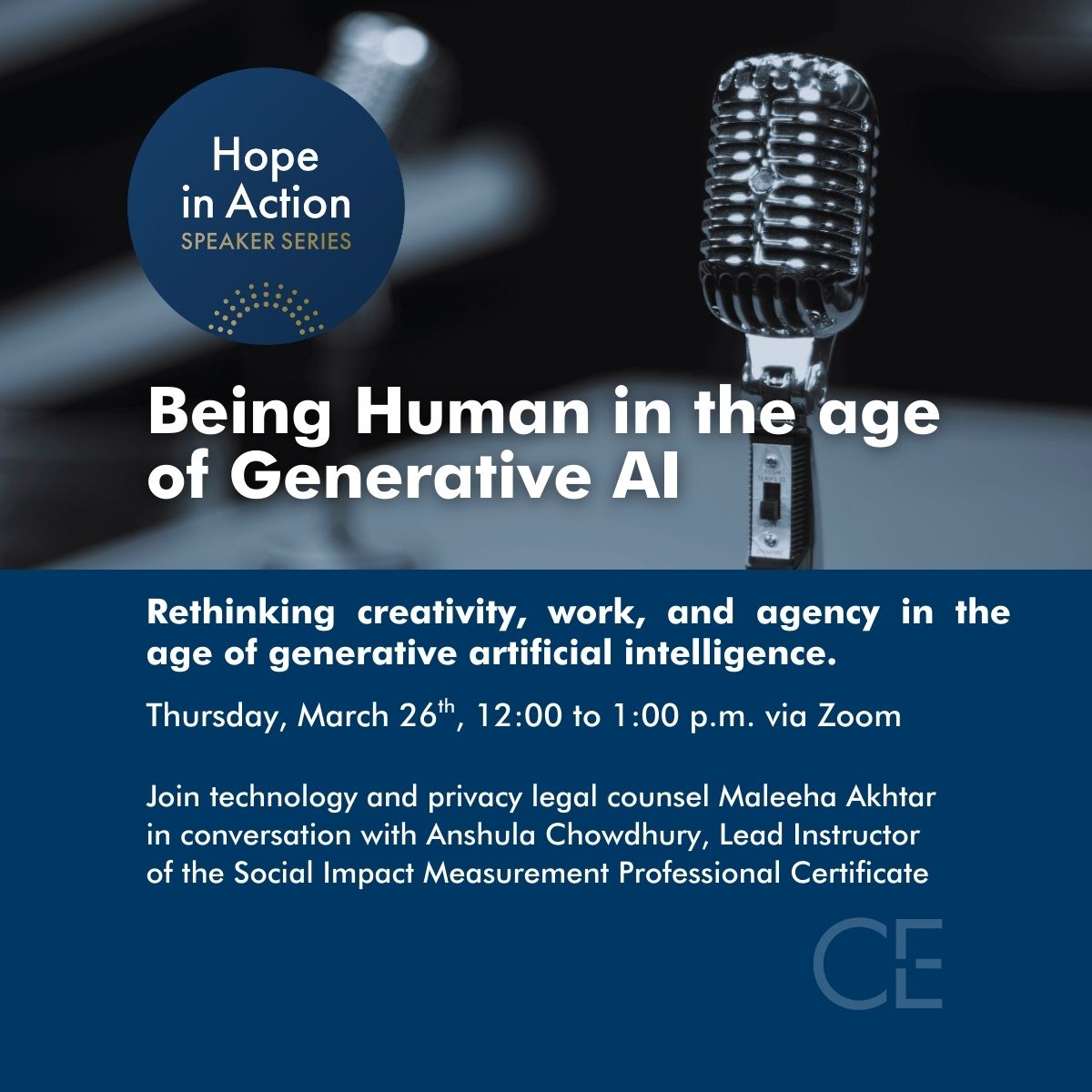
Being Human in the Age of Generative AI
Rethinking creativity, work, and agency in the age of generative artificial intelligence
We are living through a moment where tools like ChatGPT, Midjourney, and GitHub Copilot are no longer futuristic curiosities, they are genuine collaborators in our writing, coding, designing, and decision-making. This talk steps back from the hype to ask a more human question: what happens to creativity, work, and personal agency when machines can generate ideas, images, and solutions at scale?
In conversation with Anshula Chowdhury, Lead Instructor, Social Impact Measurement Professional Certificate, technology and privacy lawyer Maleeha Akhtar will explore how these systems blur lines we once took for granted between author and tool, employee and employer, automation and autonomy. We’ll consider what it means to create in an age of algorithmic assistance, how power shifts when data becomes raw material for intelligence, and how law can protect not just innovation, but dignity, fairness, and meaningful human choice.
Ultimately, this session is about ensuring that as AI grows more capable, we remain intentional about the kind of society, and the kind of human role within it, we want to build.
Future Sessions
Want to be the first to know about upcoming Hope in Action series sessions? Join our Mailing List
Subscribe to Our Mailing List
Please sign up for the latest news about our courses, programs, workshops, special lectures, and more.